
We may earn money or products from the companies mentioned in this post.
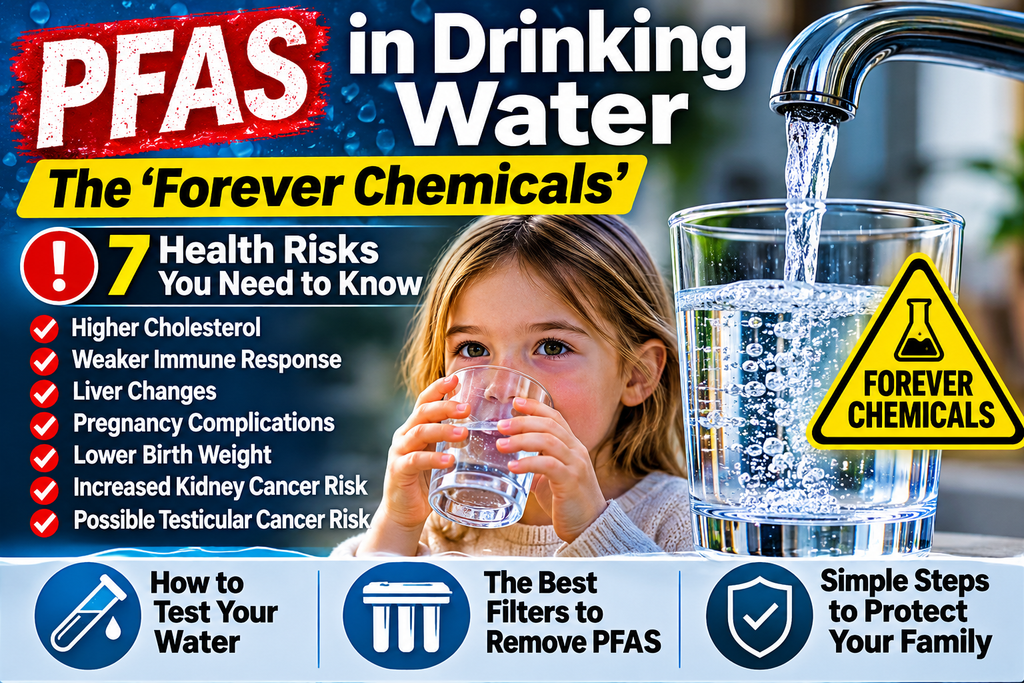
Imagine filling your child’s water bottle every morning with clear water you trust. Some drinking-water contaminants, including PFAS, are invisible and have no distinctive smell or taste. Researchers have linked exposure to certain PFAS with important health concerns—but that does not mean every tap is unsafe.
You don’t have to guess or buy the most expensive filtration system. Understand the science, check your water quality and choose a treatment system with certified claims for the substances that matter.
PFAS are not all alike, and research associations do not prove that an individual person’s illness was caused by their tap water. Here are seven health concerns, how to investigate PFAS in your home and which filtration approaches may help.
What Are PFAS and Why Are They Called Forever Chemicals?
PFAS—per- and polyfluoroalkyl substances—are a large family of manufactured chemicals used in industrial processes, firefighting foams, water-resistant materials and certain nonstick products. Many break down very slowly, and some can accumulate in the body. PFAS may enter rivers and groundwater through industrial releases, waste disposal or historical firefighting foam use. Water can contain them without a distinctive smell, color or taste. Public water systems throughout the United States have been monitoring for PFAS; private well owners may need to arrange testing themselves.
1. Increased Cholesterol Levels
Research has associated exposure to certain PFAS, particularly PFOA and PFOS, with higher cholesterol levels. High cholesterol is an established cardiovascular risk factor, although scientists continue to study what PFAS-associated changes mean for long-term outcomes. The association does not prove that PFAS caused one person’s cholesterol result.
2. Reduced Immune Response to Some Vaccines
Research links exposure to some PFAS with lower antibody responses to certain vaccinations, including in children. This does not mean vaccines become ineffective, nor does it mean everyone exposed has an immune disorder. It is one reason health agencies take drinking-water PFAS seriously.
3. Changes in Liver Enzymes
Some studies have associated PFAS exposure with changes in liver enzymes. Liver-test results can also change due to medications, infections and metabolic conditions, so an abnormal result does not diagnose PFAS exposure. Discuss any medical concerns with a healthcare professional.
4. Pregnancy-Related High Blood Pressure
Higher exposure to certain PFAS has been linked in studies with pregnancy-induced hypertension and preeclampsia. Many different factors contribute to pregnancy complications, and an association is not proof of causation in an individual case. People with documented exposure concerns should consult their healthcare professional and local health department.
5. Possible Effects on Birth Weight
Researchers have reported associations between certain PFAS and modest differences in infant birth weight. Results depend on the substances examined, timing and other factors. These findings support sensible exposure-reduction measures where contamination is documented without implying harm to every pregnancy.
6. Increased Risk of Kidney Cancer
Research has identified an association between exposure to PFOA and kidney cancer. The risks vary substantially with exposure circumstances. A cancer diagnosis cannot be attributed to PFAS from a drinking-water result alone.
7. Possible Increased Risk of Testicular Cancer
Some studies of PFOA exposure report associations with testicular cancer. The evidence remains subject to continued investigation. An association is not a prediction about an individual household’s risk.
How Much PFAS Is Allowed in US Drinking Water?
In April 2024, EPA established federal drinking-water limits for several PFAS, including 4 parts per trillion for PFOA and 4 parts per trillion for PFOS. EPA proposed revisions and compliance-date changes in 2026; proposals should not be mistaken for final rules. Verify the applicable current EPA and state rules before relying on a particular threshold or deadline. A low concentration is not measurable with an ordinary household TDS meter.
How to Find Out Whether Your Tap Water Contains PFAS
Step 1: Check your utility’s reports
Ask your municipal water provider which PFAS were tested, what concentrations were detected and whether any current health notice applies. Review published monitoring information and your Consumer Confidence Report.
Step 2: Consider local contamination sources
Private wells near airports, military facilities, industrial locations or known contamination sites may warrant special attention. Proximity is a reason to investigate—not proof of contamination. Ask local environmental or health agencies for guidance.
Step 3: Choose an appropriate laboratory
Drinking-water PFAS testing may use EPA Methods 533 or 537.1. Ask a qualified laboratory which chemicals are covered and how to avoid contaminating your sample. Regular home test strips cannot detect the low concentrations of concern.
Step 4: Interpret results accurately
PFAS are measured individually, commonly in parts per trillion. Different chemicals have different limits. Consult current federal and state guidance, rather than assuming that every detection means an emergency.
What Is the Best Water Filter for PFAS?
Not every water filter reduces forever chemicals. EPA identifies technologies including activated carbon, reverse osmosis and certain ion-exchange systems as potentially effective when appropriately designed and maintained. Choose a product based on an independently verified claim for the exact PFAS of concern.
Option 1: Activated Carbon Filtration
Activated carbon can capture certain PFAS as water passes through it. Products include pitchers, faucet mounts and under-sink systems. Effectiveness and service life vary significantly with the product, flow and water chemistry. Look for an NSF/ANSI 53 PFAS reduction claim for the exact model. A simple chlorine-taste carbon filter is not automatically effective against PFAS.
Option 2: Reverse Osmosis
Reverse osmosis uses a membrane to separate many dissolved substances from water. Certain under-sink RO systems can reduce specified PFAS alongside other contaminants, depending on their performance claims. Look for NSF/ANSI 58 certification with a specific PFAS-reduction claim. Account for membrane and cartridge replacement, space, installation and wastewater. Certification to NSF/ANSI 58 alone does not guarantee every contaminant claim.
Option 3: Specialized Ion Exchange
Selected ion-exchange resins can remove particular PFAS in appropriately designed water-treatment systems. Performance depends on resin type, water chemistry, contamination profile and maintenance. A conventional household hardness water softener is not a PFAS treatment system.
PFAS Filter Comparison: Which System Makes Sense?
| Technology | Why consider it? | Trade-off |
|---|---|---|
| PFAS-certified carbon pitcher | Affordable and renter-friendly | Lower capacity; claim varies |
| PFAS-certified faucet filter | Convenient at the sink | Cartridge life and model-specific claims |
| Under-sink carbon system | Higher drinking-water capacity | Maintenance and installation |
| Under-sink reverse osmosis | Broad potential for specified dissolved contaminants | Wastewater and membrane replacement |
| Specialized ion exchange | Can target certain PFAS | Careful sizing and media management |
| Whole-house PFAS treatment | Multiple fixtures when justified | Higher costs and professional maintenance |
Do You Need Whole-House PFAS Filtration?
Not necessarily. PFAS exposure from contaminated drinking water primarily concerns ingestion through drinking and food preparation. A certified point-of-use drinking-water filter may offer an appropriate and more economical starting point. Whole-house treatment can make sense in particular cases, but should be selected on the basis of testing and qualified design.
Five Mistakes to Avoid
- Trusting appearance: PFAS cannot be spotted, smelled or tasted.
- Buying an uncertified filter: Chlorine-taste claims do not imply PFAS reduction.
- Assuming every PFAS behaves alike: Test and product claims address specified chemicals.
- Ignoring cartridge changes: The system must be maintained within its rated capacity.
- Spending thousands before testing: Match your purchase to your actual water-quality results.
What to Do If PFAS Are Found in Your Water
Contact your utility or local health department for advice. Identify which PFAS were detected and their concentrations. Ask whether safe alternative water or treatment upgrades are being provided. Consider an independently certified drinking-water filter with claims appropriate to the substances found, and maintain it as directed. Discuss documented exposure concerns with a healthcare professional where relevant. Boiling water does not remove PFAS and can concentrate dissolved substances.
Frequently Asked Questions
Can PFAS make you sick?
Exposure to certain PFAS has been associated with changes in cholesterol, immune responses, liver enzymes, pregnancy outcomes and risks of some cancers. Individual risks vary by chemical, level and duration.
Can you taste or smell PFAS?
No. Reliable laboratory testing or utility monitoring is needed.
Does boiling remove forever chemicals?
No. Boiling is not an effective PFAS treatment.
Does reverse osmosis remove PFAS?
Some RO systems carry verified PFAS-reduction claims. Check the exact product’s NSF/ANSI 58 listing.
Will a standard pitcher remove PFAS?
Not necessarily. Some pitchers have specific PFAS certifications, but many only address taste and odor.
Can a water softener remove PFAS?
A standard water softener addresses hardness and should not be relied on to remove PFAS.
Is bottled water always PFAS-free?
No. Seek reliable testing and source information rather than assuming all bottled water is free of PFAS.
Should I have a PFAS blood test?
A blood test can measure exposure to certain PFAS, but does not predict illness or identify the exact source. Ask a healthcare professional whether testing would be useful.
How often should I test a private well?
Testing frequency depends on local risks, results and agency recommendations. There is no one-size-fits-all annual PFAS schedule.
The Bottom Line: Test, Understand, Then Treat
Forever chemicals are a genuine public-health concern, but not every American household has unsafe drinking water. Check utility reports or arrange appropriate testing. If PFAS are present, identify the chemicals and concentrations, then choose independently verified filtration tailored to the concern. For many households, a certified under-sink filter or reverse-osmosis system is a sensible first option. Don’t buy the most expensive system. Buy the system that can do the job.
Related Water Safety Guides
- Is My Tap Water Safe to Drink? 7 Hidden Contaminants
- Lead in Your Drinking Water: Warning Signs
- How to Remove Chlorine Taste and Smell
Sources and Further Reading
- CDC/ATSDR: PFAS Health Effects
- EPA: Filters Certified to Reduce PFAS
- EPA: Reducing PFAS in Drinking Water With a Home Filter
- EPA: Proposed PFAS Compliance Extension Rule
Educational information only. Consult current EPA and state guidance, your water utility, qualified testing providers, and healthcare professionals as appropriate.
Could Your Home’s Water Have Warning Signs?
Test your knowledge of water contaminants, safety and treatment in our free 15-question interactive Water Safety Check, with instant feedback and a score at the end. Take the 15-Sign Water Safety Check.
Pingback: APEC ROES-50 Review (2026): Is It Worth Buying?