
We may earn money or products from the companies mentioned in this post.
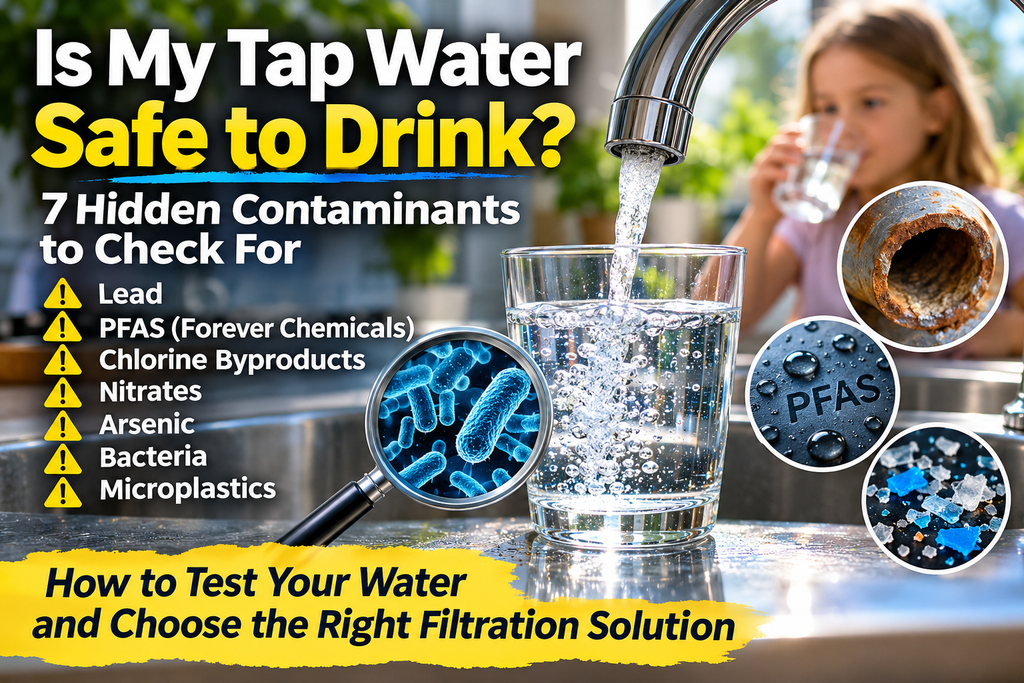
Your tap water can look clear, smell normal and taste fine while containing substances you cannot detect with your senses. That does not mean tap water is generally unsafe: most Americans on compliant public supplies can drink it routinely. But if your home has older plumbing, a private well, or nearby contamination concerns, it’s sensible to understand what to check.
Below are seven groups of contaminants worth knowing about, why they matter, how to test for them, and which water-treatment technologies may help. The goal isn’t to frighten you into buying a filter. It’s to help you choose the right solution for your actual water.
1. Lead: An Invisible Problem in Older Plumbing
Lead can enter drinking water when old service lines, solder or plumbing components corrode. It usually has no distinctive smell, taste or color. Children are particularly vulnerable to lead exposure because of potential effects on learning and development; pregnant people should also take precautions.
How to check: Ask your water utility about your service-line material and consult any available service-line inventory. If your home could have lead plumbing, arrange a drinking-water lead test with a certified laboratory and follow its collection instructions, including first-draw sampling when requested. A citywide water report cannot tell you the lead level at your own faucet.
Treatment: Use a drinking-water filter independently certified to NSF/ANSI 53 for lead reduction, or a reverse-osmosis system with an explicit verified lead claim. Check the exact model and replacement schedule. Use cold rather than hot tap water for cooking and drinking. Boiling does not remove lead. Replacing lead-containing plumbing can provide a more permanent solution.
2. PFAS: What to Know About “Forever Chemicals”
PFAS are a large group of manufactured substances used in some industrial processes and products, including certain firefighting foams. Some persist in the environment and can enter water sources. Research has associated exposure to certain PFAS with health concerns, including effects on cholesterol and immune responses. Risks vary by specific PFAS and the amount and duration of exposure.
How to check: Review your public utility’s PFAS monitoring information or contact the local health department if you have a private well near a possible contamination site. A qualified laboratory can test drinking water using suitable methods, such as EPA Methods 533 or 537.1. Standard home strips and TDS meters cannot meaningfully screen for these substances.
Treatment: Certain activated-carbon filters and reverse-osmosis systems reduce specified PFAS. Look for NSF/ANSI 53 or NSF/ANSI 58 certification with a specific PFAS-reduction claim. A broad claim that a system removes “chemicals” is not enough. EPA rules and proposed revisions evolve, so check current federal and state guidance.
3. Nitrates: Especially Important for Homes With Babies
Nitrates can reach groundwater from fertilizer, animal waste and septic systems. This matters particularly in farming areas and for private wells. Elevated nitrates in water used to prepare infant formula can cause methemoglobinemia, a serious condition sometimes called “blue baby syndrome.”
The federal drinking-water limit for nitrate is 10 mg/L measured as nitrogen (NO₃-N). Laboratories sometimes report nitrate in different units, so compare results carefully.
How to check: Arrange annual nitrate testing for private well water and test after conditions that could affect the well. Treatment: Appropriate reverse-osmosis or nitrate-selective ion-exchange systems can reduce nitrate. Ordinary carbon pitchers and conventional water softeners are not reliable nitrate treatments. Do not boil nitrate-contaminated water to try to make it safe; use a confirmed safe alternative and follow public-health guidance.
4. Arsenic: A Natural Groundwater Concern
Arsenic occurs naturally in certain rocks and soils and can enter groundwater without changing its taste or appearance. Long-term exposure at elevated levels is associated with several serious health effects, including increased cancer risks. The federal drinking-water limit is 10 micrograms per liter (10 parts per billion).
How to check: Ask your local health department whether arsenic is common in your area and use a qualified laboratory for testing. Treatment: Depending on the form of arsenic and your water chemistry, treatment may include reverse osmosis or specialized adsorptive media. Standard carbon pitchers should not be assumed to remove arsenic. Seek a verified arsenic-reduction claim and professional advice for elevated results.
5. Bacteria and Other Microorganisms: A Priority for Private Wells
Flooding, damaged well components, septic problems and runoff can allow disease-causing organisms into water. Clear-looking water is not proof that it is microbiologically safe. Private well owners should arrange annual testing for total coliform bacteria and nitrates, alongside other recommended measures. An E. coli finding can signal fecal contamination and needs urgent attention.
How to check: Collect samples exactly as instructed by a certified laboratory and test after floods, repairs or changes in water quality. Treatment: Depending on the cause, properly designed UV disinfection, chemical treatment, well repairs and follow-up tests may be necessary. UV treatment does not remove chemicals such as PFAS, lead or nitrate. Ordinary carbon filters do not necessarily make unsafe well water safe. Follow local health-department or utility instructions and use an appropriate safe source until the issue is resolved.
6. Disinfection Byproducts: A Different Issue From Chlorine Smell
Municipal water is disinfected to protect people from harmful microbes. When disinfectants react with naturally occurring organic material, they can create disinfection byproducts, including regulated trihalomethanes (TTHMs) and haloacetic acids (HAA5). Long-term exposure to elevated levels of some byproducts has been linked to health risks.
How to check: Review your utility’s annual Consumer Confidence Report and published notices. A chlorine smell is not a direct measurement of disinfection byproducts. Treatment: Certain well-designed activated-carbon systems can reduce specific byproducts, but effectiveness depends on the compound, flow and maintenance. Whole-house treatment needs careful sizing and attention to plumbing hygiene. If your concern is simply taste, see our guide to removing chlorine taste and smell from tap water.
7. Microplastics and Emerging Contaminants
Researchers have detected microplastic particles and certain emerging chemicals in some water supplies. Their health effects at typical drinking-water exposure levels are still being studied. A finding that particles are present does not by itself establish an immediate health risk.
How to check: Specialized laboratory testing may be needed and is not always practical for routine household use. Treatment: Appropriately designed fine filtration and reverse osmosis may reduce certain particles. For other emerging chemicals, check precise contaminant-specific performance claims. Prioritize established local risks and water tests before buying equipment based on broad marketing promises.
How to Find Out Whether Your Tap Water Is Safe
- Identify your source. Are you on a regulated public supply or a private well?
- Read your water report. For public water, look up your utility’s Consumer Confidence Report, monitoring results and current advisories.
- Test the water at your faucet. Choose a certified laboratory and tests based on your plumbing, geography and concerns. For well water, follow annual testing guidance.
- Match the treatment to the result. Don’t buy a system just because the packaging mentions “clean water.”
- Check the certification and maintenance costs. Independently verified claims for the exact contaminant matter more than a manufacturer’s broad list of substances.
A cheap TDS meter measures dissolved ionic material. It cannot establish whether your water is free of lead, PFAS, disease-causing microorganisms or other health-relevant contaminants.
Which Water Filtration System Makes Sense?
| Technology | Typical purpose | Important limitation |
|---|---|---|
| Certified carbon pitcher or faucet filter | Specified taste/odor concerns and contaminants such as lead on certain models | Not every model removes PFAS, nitrate or arsenic |
| Under-sink reverse osmosis | Broad range of specified dissolved drinking-water contaminants | Must verify exact claims; has maintenance and wastewater costs |
| Whole-house activated carbon | Some chemicals and disinfectant-related taste/odor at multiple fixtures | Does not ordinarily soften water or disinfect it |
| Ion-exchange softener | Hardness minerals and scale | Not a general-purpose health-contaminant filter |
| Specialty media / ion exchange | Specific contaminants such as nitrate or arsenic | Requires correct water chemistry and sizing |
| UV disinfection | Inactivation of specified microorganisms | Does not remove dissolved chemicals |
No single filter removes everything. Under-sink treatment is often a sensible starting point when concerns relate mainly to water used for drinking and cooking. Whole-house systems may be appropriate when a confirmed problem affects multiple fixtures, but they cost more and need careful maintenance.
Five Mistakes to Avoid
- Assuming clear water is contaminant-free.
- Buying filters without checking a certified claim for the contaminant that matters.
- Assuming boiling removes chemical contaminants such as lead, nitrate or PFAS.
- Ignoring cartridge replacement and treatment-system maintenance.
- Paying for expensive whole-house equipment before finding out what is in your water.
Frequently Asked Questions
Is American tap water generally safe to drink?
Water from compliant regulated public supplies is generally safe for routine use, but local contamination and plumbing problems can occur. Check official advisories and your utility report. Private wells require owner-arranged testing.
Can my city’s water report tell me if my home has lead?
No. It provides useful system information, but lead can also enter water through your own service line or plumbing. Testing at your tap gives more relevant information.
Does reverse osmosis remove PFAS?
Some reverse-osmosis products are certified to reduce specified PFAS. Verify the exact model’s NSF/ANSI 58 claims and maintenance requirements.
Does boiling water remove lead or nitrates?
No. Boiling is not a reliable way to remove dissolved chemical contaminants. It can concentrate some substances as water evaporates.
Do I need a whole-house water filter?
Not necessarily. Start with your water quality data and what you need to treat. A certified under-sink system may be more cost-effective for drinking-water concerns.
The Bottom Line: Test First, Then Choose
You do not need to be frightened of your tap water. You need reliable information about it. Look up your utility’s report, check older plumbing where relevant, arrange appropriate testing and select treatment that is independently verified for the contaminants you find.
For another common household water concern, see why water smells like rotten eggs. Remember, odor alone isn’t a reliable drinking-water safety test.
Sources and Further Reading
- US EPA: National Primary Drinking Water Regulations
- US EPA: Lead in Drinking Water
- US EPA: Filters Certified to Reduce PFAS
- CDC: Guidelines for Testing Well Water
- NSF: Standards for Water Treatment Systems
Editorial note: This guide is educational and does not replace official water-safety notices, professional testing or healthcare advice. Standards and certifications can change; verify current requirements and exact product claims before relying on a treatment system.
Could Your Home’s Water Have Warning Signs?
Test your knowledge of water contaminants, safety and treatment in our free 15-question interactive Water Safety Check, with instant feedback and a score at the end. Take the 15-Sign Water Safety Check.
Pingback: Could There Be Lead in Your Drinking Water? 7 Warning Signs and How to Protect Your Family - Home Filtration Expert
Pingback: PFAS in Drinking Water: 7 Health Risks of Forever Chemicals and How to Protect Your Family - Home Filtration Expert
Pingback: Can Hard Water Cause Hair Loss? 7 Warning Signs and How to Protect Your Hair - Home Filtration Expert
Pingback: Brita Tahoe Elite Filter Review (2026): Worth It?
Pingback: APEC ROES-50 Review (2026): Is It Worth Buying?