
We may earn money or products from the companies mentioned in this post.
Most of us turn on the kitchen tap a dozen times a day without a second thought. We fill the coffee maker, rinse the vegetables, top off the dog’s bowl, and mix a bottle of formula, all on the quiet assumption that whatever comes out of the faucet is safe.
For most people in developed countries, that assumption holds up pretty well.
For millions of households in the United States, though, there is a catch. The water leaves the treatment plant clean and picks up lead on the final stretch, in the pipes and fittings under the street and inside the house itself.
Lead has no color, no taste, and no smell. You can pour a glass that is crystal clear and perfectly normal-looking, and it can still carry a meaningful dose.
Because of that, “warning signs” is a slightly generous term.
Most of them are clues that raise your odds and tell you where to look. Only testing gives you a real answer.
The good news is that lead in water is one of the most fixable health hazards out there. Once you know where it comes from, how to confirm it, and what to do about it, you can cut your family’s exposure dramatically.
A quick note on numbers: regulations in this area keep changing, so check current limits and timelines on the EPA’s website before relying on any specific figure here.
Why Lead Gets Into Tap Water
The water at the reservoir, river, or well is rarely the problem. Lead gets into tap water almost entirely through corrosion, the slow chemical wearing away of lead-bearing plumbing as water travels through it.
The pipes under the street, the service line connecting the main to your house, the solder joining copper pipes, and the brass inside your faucet can all contribute.
Lead was used in plumbing for thousands of years because it is durable and easy to bend. The word “plumbing” comes from plumbum, the Latin word for lead.
The Romans ran lead pipes through their cities, and Benjamin Franklin wrote in the 1700s about the illness he saw among plumbers and printers who handled lead.
In the United States, some city codes in the early twentieth century actually required lead service lines. The 1986 Safe Drinking Water Act amendments restricted the use of lead-containing pipes and solder in drinking-water plumbing; subsequent laws tightened the definition of lead-free fixtures.
Any home with plumbing installed before then may have lead somewhere in the system.
Water Chemistry Decides Everything
Whether lead dissolves into your water depends heavily on the water’s chemistry. Utilities add corrosion-control treatments, most commonly orthophosphate, which helps build a protective mineral coating on the inside of pipes.
Think of it as a thin glaze inside a clay pot.
While the glaze stays intact, the lead underneath stays put. Change the chemistry and the glaze can crack, dissolve, or flake away.
That is what happened in Flint, Michigan. In 2014 the city switched its water source without adequate corrosion control.
The more aggressive water stripped the protective scale from old pipes, and lead levels in homes climbed. Pediatrician Mona Hanna-Attisha’s data on rising blood lead levels in local children, along with water testing led by Virginia Tech professor Marc Edwards, helped expose the problem after officials had downplayed it.
Flint was not the first case. In Washington, D.C., a disinfectant change in the early 2000s led to elevated lead across the city.
More recently, Newark, New Jersey, faced corrosion control failures that led to large filter distribution and faster line replacement, and Benton Harbor, Michigan, dealt with elevated lead and a bottled-water response.
Jackson, Mississippi, has struggled with broader water system failures too. Changes in treatment and corrosion control can substantially affect lead exposure in vulnerable plumbing systems.
Why Even Small Amounts Matter
No safe level of lead exposure has been identified, particularly for children. The EPA’s health-based goal for lead in drinking water, called the maximum contaminant level goal, is zero.
The EPA’s 2024 Lead and Copper Rule Improvements established a 10 parts-per-billion action level, with key compliance requirements beginning in 2027. Federal requirements and litigation can change; consult current EPA guidance. The action level is a regulatory trigger, not a health-based safe threshold.
It is not a safety line, even though plenty of people assume anything below 15 ppb must be fine.
Regulatory compliance sampling uses a system-level 90th-percentile calculation. A utility’s compliance status does not tell you the concentration at your own faucet. Critics have pointed out that some utilities have skewed results by pre-flushing taps, removing aerators, or picking low-risk homes for testing.
For comparison, the World Health Organization’s guideline is 10 micrograms per liter, and the European Union has been moving toward 5.
What Lead Does to the Body
Children are the most vulnerable. They absorb a larger share of ingested lead than adults do, and their brains are still developing.
Research by Bruce Lanphear and colleagues showed IQ declines at blood lead levels below 10 micrograms per deciliter, with a steeper effect per unit of lead at lower levels.
Long-running cohort studies, including the Dunedin study in New Zealand, have linked childhood lead exposure with lower adult IQ and poorer life outcomes. Lead’s effects on attention and behavior are easy to mistake for other conditions, and the neurological damage in children is largely irreversible.
Adults are affected too. Chronic exposure is linked to higher blood pressure, cardiovascular disease, kidney damage, and reproductive problems.
Lead also stores in bone for years, and during pregnancy that stored lead can mobilize and cross the placenta.
A past exposure can become a present one.
The CDC’s blood lead reference value for children, updated in 2021, is 3.5 micrograms per deciliter. That number is not a safe threshold either.
It flags children whose levels are higher than most of their peers so families and doctors can look for the source.
Water is not the only route. Lead paint, contaminated soil and dust, and certain imported goods all contribute.
Water is commonly estimated at around 20 percent of total lead exposure, and for formula-fed infants whose powder is mixed with tap water, that share can climb to somewhere between 40 and 60 percent.
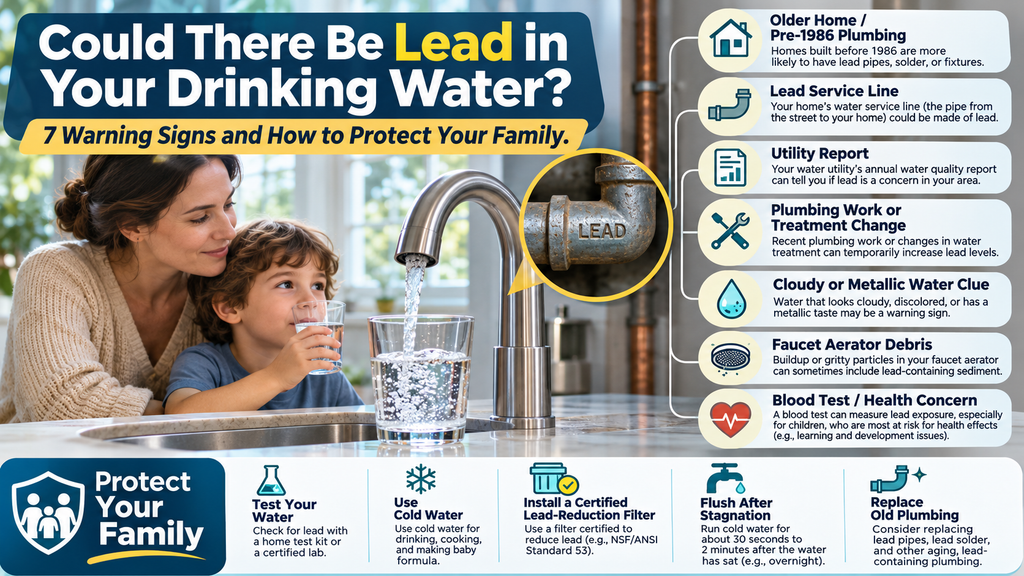
7 Warning Signs You Could Have Lead in Your Water
None of these is a diagnosis. Each one is a good reason to test.
1. Your Home Was Built Before 1986
This is an important reason to investigate, but age alone cannot establish that lead is present. Homes built before 1986 may have lead pipes, lead solder, or leaded brass fixtures.
If your home predates the 1950s, the odds of a lead service line go up considerably.
Even if the street-side pipe has been replaced, old interior plumbing can still leach lead.
2. You Have a Lead Service Line
The service line carries water from the main under the street into your house. Find where it enters, usually near the water meter in a basement or utility area.
Lead pipe is dull gray, soft enough to scratch to a shiny silver with a key, and non-magnetic.
Copper is orange-brown. Galvanized steel is gray but sticks to a magnet.
Do not damage, gouge or disturb the pipe. Ask your water utility or a qualified plumber to verify suspected lead service lines.
Many utilities now publish service line inventories. They can be buried on a website, so call your utility directly if you can’t find yours.
3. Your Utility Reports Lead Problems
Your water provider has to send you an annual Consumer Confidence Report. Actually read it.
Look for lead exceedances, corrosion control changes, or notices about treatment adjustments.
If something changed recently, test even if the numbers look fine.
4. There Has Been Plumbing Work or a Treatment Change
Road work, water main replacements, and shifts in disinfectant, such as a switch to chloramine, can disturb the protective scale in pipes. Partial service line replacement deserves special attention.
Swapping out only part of a lead line can temporarily raise lead levels by disturbing existing scale and creating galvanic corrosion where different metals meet.
5. Discolored or Metallic-Tasting Water (Not a Reliable Lead Test)
Discolored water usually points to iron or sediment, not lead, and people mix the two up all the time. Still, rusty or cloudy water suggests corroding plumbing somewhere, and where there is corrosion, it makes sense to test for lead too.
Clear water proves nothing, so a pristine glass should not talk you out of testing.
6. Flakes or Debris in Your Faucet Aerators
Unscrew the little screen at the tip of your faucet. Metallic grit, flakes, or sediment deserve attention.
Lead can show up as tiny particles as opposed to dissolved metal, which is one reason test results can swing wildly from one sample to the next.
7. An Elevated Blood Lead Test or Exposure Concern
Lead poisoning in children can show up as irritability, learning difficulties, delayed development, abdominal pain, and fatigue. In adults it may appear as headaches, memory problems, joint pain, and high blood pressure.
Every one of these symptoms has many other possible causes, and many children with elevated blood lead have no symptoms at all.
A blood lead test can identify elevated exposure in a person, but it does not establish that drinking water is the source.
Key Insight: A home with none of these signs can still have lead, and a home with several may test clean. Use the signs as a reason to test, never as a replacement for testing.
How to Test Your Water Properly
This is where people waste money. Cheap test strips and many consumer kits are not reliable at the low levels that matter.
A strip that says “no lead detected” may simply be unable to detect anything below a threshold well above what is concerning.
Start with your utility. Many offer free or discounted lead testing and can tell you which labs near you are certified. Your state or local health department is another good source.
Use a state-certified lab. Certification means the lab follows validated methods and gets audited. Ask for sampling instructions and follow them exactly.
Collect a first-draw sample. This is water that has sat in your pipes for at least six hours, typically overnight, before anyone uses a tap or flushes a toilet. It captures the most lead that has had time to leach in. Many labs will also want a second sample after flushing so you can compare.
If lead is higher in the first draw and drops after flushing, the source is probably your interior plumbing or fixtures. If it stays high after flushing for a while, the service line becomes the prime suspect.
Test the right taps. Test the kitchen tap you drink from and any tap you use to prepare infant formula. Different plumbing runs can give different results, so a clean bathroom sink does not guarantee a clean kitchen faucet.
Consider testing with and without the aerator. Particles trapped in the screen can skew results, and comparing the two samples shows whether debris is a factor.
Pro Tip: Because lead can arrive as particles, results vary from draw to draw. If results are uncertain, ask the lab or utility whether repeat sampling is appropriate. One sample cannot characterize every possible change in lead levels.
Talk to your pediatrician too. A blood lead test is the only direct measure of exposure, and it is worth asking about for toddlers in particular.
Blood tests reflect recent exposure, while lead stored in bone stays hidden.
How to Protect Your Family Right Now
Waiting for test results, or for a utility to replace a pipe, can take weeks or years. There is plenty you can do in the meantime.
Use Cold Water Only
Use cold water for drinking, cooking, and mixing formula. Hot water can contain more lead leached from plumbing.
This habit costs nothing.
Flush When Water Has Been Sitting
After several hours of stagnation, such as first thing in the morning or after a long weekend away, run the cold tap until the water turns noticeably colder, which suggests fresh water is arriving from the main. Your utility may have specific guidance on duration. Flushing is a stopgap.
A temperature change does not prove the water is lead-free, and with a lead service line, flushing helps only so much while wasting a lot of water.
Install a Certified Filter
Look for an independently certified NSF/ANSI 53 lead-reduction claim (and particulate reduction under NSF/ANSI 42 where applicable) or NSF/ANSI 58 for a reverse osmosis system with a verified lead-reduction claim. Not every filter that claims to remove “contaminants” handles lead, and pitcher filters vary a lot in performance.
Check the packaging for the specific lead claim and verify it in the certifier’s public database.
Then replace the cartridge exactly on schedule. An overdue filter gives you false confidence while doing very little.
If your refrigerator dispenses ice and water, check that it uses a lead-certified cartridge.
Ice, coffee, and baby formula are easy to forget when you only think about drinking glasses.
Reverse osmosis works well but wastes a fair amount of water in the process.
Clean Your Aerators
Unscrew and rinse them every few months. It takes two minutes and removes particles that may contain lead.
Take Extra Care With Infants and Pregnancy
Formula-fed infants can get a big portion of their lead intake from water, so use filtered cold water for mixing. Pregnant family members should do the same and talk with their doctor about testing.
Skip the Boiling
Boiling does not remove lead. It can concentrate it slightly as water evaporates.
Bottled water is no automatic fix either, since it is not necessarily tested more thoroughly than tap water.
Fixing the Source: Replacing Lead Lines and Fixtures
Filters are a bridge. The real fix is removing the lead.
Who Owns What
The service line is usually split between the utility, which owns the public side up to the property line, and the homeowner, who owns the private side. Split responsibility has slowed replacement for years, and homeowners often face thousands of dollars for their share.
Push for Full Replacement
Partial replacement can temporarily spike lead levels by disturbing scale and joining dissimilar metals. Ask for full replacement from the main to your home whenever possible.
If any work is done on your line, flush thoroughly afterward and use a certified filter for as long as your utility recommends.
Funding is easier to find than it used to be. The Bipartisan Infrastructure Law set aside tens of billions of dollars for lead pipe replacement, and many cities have grants or low-interest programs.
Ask your utility what is available in your area.
Check Fixtures and Fittings
Sometimes the main culprit is a single old brass faucet, a lead solder joint, or a short lead connector called a pigtail. Before 2014, “lead-free” brass could legally contain up to 8 percent lead.
Since then the limit is a weighted average of 0.25 percent.
Even new “lead-free” faucets can leach small amounts early on, so run the tap for a while and consider filtering at first.
Common Mistakes to Avoid
Trusting your senses. Clear, odorless, great-tasting water tells you nothing about lead.
Buying the wrong filter. A filter marketed for taste and chlorine may do nothing for lead. Look for the specific NSF/ANSI certification.
Forgetting cartridge changes. Set a calendar reminder the day you install the filter.
Assuming your neighbor’s result is yours. One house can test clean while the house next door does not, because lead often hides in the person pipe, fitting, or fixture.
Treating flushing as permanent. It works as a daily habit and does nothing about the source.
Ignoring other lead sources. Paint in older homes, soil, dust, and some imported ceramics add up. If a child has an elevated blood level, audit the whole household.
Adapting This to Your Situation
If you rent, ask your landlord what the plumbing is made of and whether test results exist. Plumbing disclosure is patchy compared with lead-paint rules, so persistence helps.
Your local health department can step in if you hit a wall.
A certified faucet-mounted or pitcher filter is an easy renter-friendly step.
If you’re on a private well, the EPA does not regulate your water, so testing is up to you. Test annually and after any change in plumbing or water chemistry.
Acidic well water is especially prone to corroding pipes.
If you have a water softener, remember that a standard softener is not a certified lead-reduction filter. Test your water and choose treatment with a verified lead claim.
If your kids attend school or daycare, ask what the facility does. After the 1988 Lead Contamination Control Act, testing was encouraged but not widely required, though several states have since added requirements.
If you have pets, ask your veterinarian if you have concerns about their water exposure.
Where This Fits in the Bigger Picture
The estimated number of lead service lines in the U.S. is commonly cited at roughly 9 million, though newer inventories point to somewhere between 4 and 9 million. In 2021 the EPA announced a goal of replacing all of them, and the 2024 Lead and Copper Rule Improvements would need most systems to replace lead lines within about a decade and lower the action level to 10 ppb.
Legal challenges may have shifted some details, so check the latest status.
Disadvantaged communities often have older infrastructure and fewer resources, which is why lead has become an environmental justice issue. Knowing your own situation makes you a better advocate for your neighborhood.
People Also Asked
How do I know if my water has lead in it?
You can’t see, taste, or smell lead, so the only reliable way is a test from a state-certified lab. Contact your utility or health department for approved labs and sampling instructions.
Does boiling water remove lead?
No. Boiling can concentrate lead slightly as water evaporates. A certified filter is a far better option.
What type of water filter removes lead?
Look for filters certified to NSF/ANSI Standard 53 for lead or Standard 58 for reverse osmosis. Confirm the lead claim in the certifier’s database.
Is lead in tap water common in older homes?
Yes. Homes built before 1986 are the most likely to have lead pipes, solder, or leaded brass fixtures, and the risk rises for homes built before the 1950s.
How can I tell if my service line is lead?
Scratch the pipe lightly with a key near where it enters your house. Lead turns shiny silver and does not attract a magnet.
Is lead in drinking water dangerous for babies?
Yes. Infants absorb more lead than adults, and formula mixed with tap water can make water a major share of their exposure.
What is the safe level of lead in drinking water?
The EPA’s goal is zero. A regulatory action level is a trigger for utility action, not a safe exposure threshold; see the EPA’s current Lead and Copper Rule guidance.
Can lead pipes make you sick if the water looks clear?
Yes. Clear water can still carry lead, which is why testing matters more than appearance.
Does hot water have more lead than cold water?
Hot water tends to pull more metals from plumbing, so use cold water for drinking, cooking, and formula.
Is partial lead pipe replacement safe?
It can temporarily raise lead levels by disturbing scale and creating galvanic corrosion. Full replacement is the better choice.
Key Takeaways
Lead has no color, taste, or smell, so testing through an appropriate certified laboratory is the reliable way to determine whether it is present in drinking water. There is no known safe level of lead exposure for children. Homes built before 1986 carry the highest risk, and the seven warning signs are clues that point toward testing.
Use cold water for drinking, cooking, and formula, flush after stagnation, and install a filter certified to NSF/ANSI 53 or 58 while replacing the cartridge on schedule.
Boiling doesn’t remove lead, partial line replacement can temporarily make things worse, and the long-term fix is full removal of lead lines and fixtures.
Related Water Safety Guides
If you are concerned about more than lead, read our guide to seven hidden drinking-water contaminants. For unpleasant chlorine taste, see how to remove chlorine taste and smell from tap water.
Sources
- EPA: Basic Information About Lead in Drinking Water
- EPA: Lead and Copper Rule Improvements
- CDC: About Lead in Drinking Water
- NSF: Water Treatment Standards
Educational information only. Follow your water utility’s current guidance and seek qualified medical advice for possible exposure.
Could Your Home’s Water Have Warning Signs?
Test your knowledge of water contaminants, safety and treatment in our free 15-question interactive Water Safety Check, with instant feedback and a score at the end. Take the 15-Sign Water Safety Check.
Pingback: PFAS in Drinking Water: 7 Health Risks of Forever Chemicals and How to Protect Your Family - Home Filtration Expert
Pingback: Why Is My Tap Water Brown or Orange? 7 Possible Causes, Health Risks and How to Fix It - Home Filtration Expert
Pingback: APEC ROES-50 Review (2026): Is It Worth Buying?