
We may earn money or products from the companies mentioned in this post.
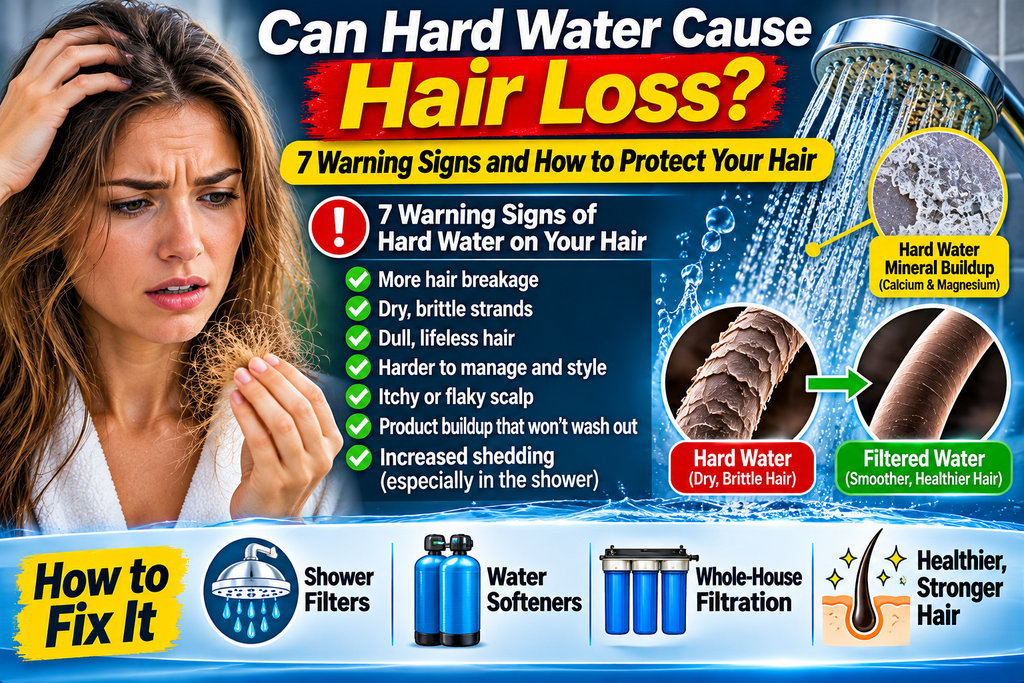
You’ve changed shampoos, invested in conditioners and tried gentler styling—but your hair still seems dry, tangled or brittle. Could the water coming from your shower be part of the problem?
For US homeowners with hard water, that question is worth investigating. But there’s an important distinction between hair breakage and hair loss from the scalp. Understanding the difference could save you money and help you choose the right solution.
Can Hard Water Really Cause Hair Loss?
Hard water can affect how hair feels and behaves, but it is not an established direct cause of permanent hair loss. Water hardness comes mainly from dissolved calcium and magnesium. Those minerals can build up on hair fibers, affect styling and potentially contribute to breakage. Losing hair at the root is a different process, with causes that include genetics, hormonal changes, illness, certain medications and nutritional deficiencies.
Laboratory studies on hard water and hair strength have produced mixed results. One reported reduced tensile strength after hard-water exposure, while another found no significant change. A more recent research synthesis suggests hard water probably increases breakage but stresses that stronger real-world studies are needed. That is why this guide focuses on identifying the problem rather than promising a water filter can reverse hair loss.
Hair Breakage vs. Hair Shedding: Know the Difference
Breakage happens when an existing hair shaft snaps. You might notice shorter pieces, rough ends, tangling or uneven lengths. Shedding happens when an entire strand leaves the follicle, often with a tiny bulb at one end. Gradual thinning at the crown, a widening part, bald patches or unusual amounts of full-length shed hair deserve medical assessment—not simply a new showerhead.
You may experience both at once. Water hardness can be one part of a hair-care problem without being the medical explanation for hair loss.
7 Warning Signs Your Hard Water May Be Affecting Your Hair
1. Your Hair Feels Rough or Coated After Washing
If your hair feels unusually stiff, waxy or difficult to rinse clean, mineral deposits may be contributing. Styling products and shampoos can produce similar buildup, so this clue is not proof of hard water.
2. Your Hair Breaks When You Brush or Style It
Short snapped pieces are different from full-length shed hairs. Hard-water exposure may affect the hair fiber’s mechanical properties, but heat styling, chemical treatments, friction and tight hairstyles are also common sources of breakage.
3. Your Hair Tangling Has Become Worse
Hair that tangles easily is more likely to be pulled and damaged during detangling. Dryness, weathering and accumulated products may all play a role. A gentler routine can often help, even before you change your water supply.
4. Your Hair Looks Dull Despite Conditioning
Mineral deposition may affect surface characteristics and styling results. If your hair has lost shine, consider product buildup, heat damage and water hardness together instead of assuming one cause.
5. Your Scalp Feels Dry or Uncomfortable
Some people report scalp discomfort when washing in mineral-rich water, but itching and flaking can also come from dandruff, eczema, contact reactions and other conditions. Persistent inflammation, soreness, scaling or hair loss warrants a clinician’s advice.
6. Your Hair-Care Products Seem Less Effective
Hard water can interact with soaps and affect how easily some cleansing products rinse. You may find yourself using more shampoo or struggling to achieve the finish you expect. This is a reason to investigate your water hardness, not evidence of permanent hair damage.
7. You See Limescale Around Your Shower
White chalky residue on taps, shower glass and fixtures is a practical clue that your home’s water may be hard. It does not establish that the water is making you lose hair. Confirm with your utility’s water-quality report or a hardness test.
How to Tell If You Have Hard Water
Start with your municipal water utility’s published hardness information, if available. Home hardness strips can provide a rough estimate; laboratory testing is useful when you need a more detailed assessment. Hardness is usually reported in milligrams per liter (mg/L) as calcium carbonate or grains per gallon (gpg).
| Hardness, mg/L as CaCO3 | Common USGS description |
|---|---|
| 0–60 | Soft |
| 61–120 | Moderately hard |
| 121–180 | Hard |
| Over 180 | Very hard |
The classification describes water chemistry, not a medical risk score for your hair.
How to Protect Your Hair from Hard Water
1. Try a gentle clarifying routine
An occasional clarifying or chelating shampoo formulated for mineral buildup may help remove deposits. Follow product instructions and avoid harsh over-washing, particularly for colored, curly or chemically treated hair.
2. Use conditioner and reduce friction
Condition regularly, detangle gently with appropriate tools and avoid excessive heat. These simple steps may reduce breakage regardless of what is in the water.
3. Confirm whether hardness is the real problem
Test your water rather than buying a product based only on advertisements. A filter marketed for chlorine reduction and a true hardness-removal system solve different problems.
4. Consider a properly sized water softener
A conventional ion-exchange water softener reduces calcium and magnesium by exchanging them for other ions. If your home has very hard water, softening may address scale around the house as well as mineral exposure during bathing. Choose a qualified installer, consider operating costs and follow local plumbing guidance.
5. Don’t confuse a shower filter with a water softener
Many shower filters are designed to reduce chlorine. NSF/ANSI 177 relates to shower-filter chlorine-reduction claims, not certification that a device softens hard water. Read the product’s actual performance sheet and avoid assuming a small shower cartridge removes dissolved calcium and magnesium.
Shower Filter vs. Water Softener: What’s Worth Buying?
| Product | What it may do | What to check |
|---|---|---|
| Clarifying or chelating shampoo | Helps manage product or mineral deposits on hair | Suitability for hair type and color treatment |
| Shower filter | Some models reduce free chlorine | Specific certified chlorine-reduction claim |
| Whole-house ion-exchange softener | Reduces calcium and magnesium hardness | Independent performance claims, capacity, maintenance and installation |
| Whole-house filtration | Targets specified contaminants depending on media | Whether it actually addresses hardness; many systems don’t |
If the real complaint is limescale and mineral buildup, a genuine water softener is generally more relevant than a chlorine-only shower filter. If the concern is chlorine odor or taste, see our separate guide to removing chlorine taste and smell.
When to See a Doctor About Hair Loss
Don’t blame your water if you’re noticing sudden shedding, distinct bald patches, scalp pain, significant scaling, a receding hairline or a rapidly widening part. These patterns can signal medical causes that deserve examination. A dermatologist or other qualified clinician may check for pattern hair loss, alopecia areata, scalp conditions or other contributors and recommend appropriate treatment.
Switching water filters is not a substitute for evidence-based treatment of hair-loss conditions.
Frequently Asked Questions
Does hard water cause permanent baldness?
There is insufficient evidence that hard water directly causes permanent follicle loss or male- or female-pattern baldness. It may contribute to hair-fiber damage or breakage in some circumstances.
Can a shower filter stop hair loss?
No shower filter has been established as a treatment for medical hair loss. Chlorine-reduction filters generally don’t remove the calcium and magnesium responsible for water hardness.
How long does it take to notice a difference with soft water?
Results vary. Someone bothered by mineral buildup may notice easier rinsing or improved manageability after changing their routine or water treatment, but there is no guaranteed timetable and it does not prove restored hair growth.
Is hard water unsafe to shower in?
Hardness alone is usually a nuisance affecting cleaning, scale and appliance performance, not proof that shower water is dangerous. Other water-quality concerns should be assessed separately.
Can I test for hard water at home?
Yes. Water hardness strips can offer a starting estimate, while your utility or a qualified laboratory can provide more reliable information.
The Bottom Line
Hard water may make hair feel rough, dull or difficult to manage, and some research links it to breakage. But breakage is not the same thing as medically significant hair loss. Check your water hardness, improve your hair-care routine and choose treatment based on the actual problem. If you’re experiencing thinning or unusual shedding, speak with a healthcare professional.
For related issues, read why skin may feel dry or itchy after showering and our drinking-water safety guide.
Sources and Further Reading
- Study: Hair strength after exposure to hard water
- Study: Effects of hard water on hair
- Study: Mineral deposition and hair surface changes
- NSF: Shower filter certification and chlorine reduction
- USGS: Water hardness
Educational information only. This guide does not diagnose or treat hair-loss disorders. Some product links may be affiliate links when added to this site.