
We may earn money or products from the companies mentioned in this post.
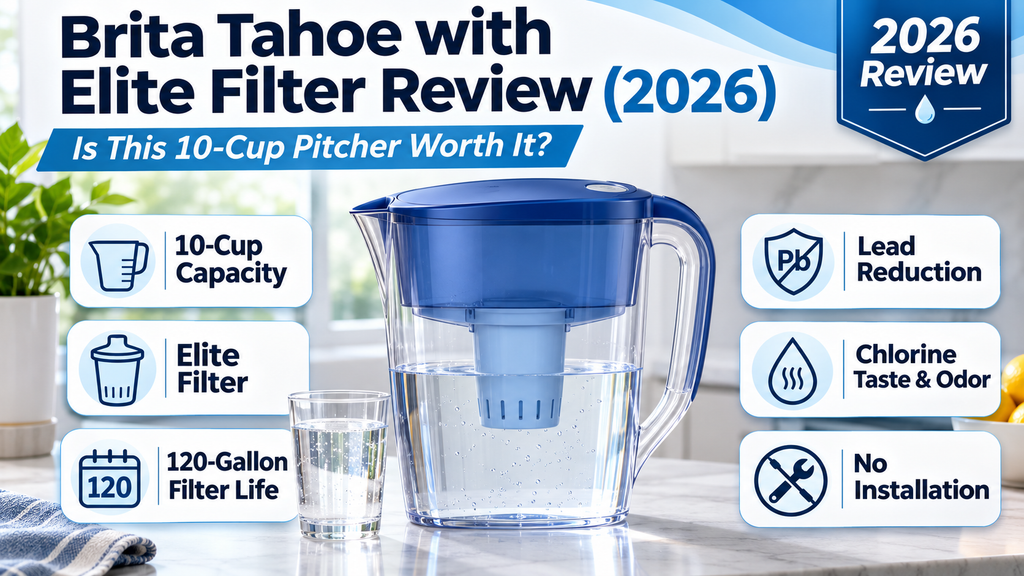
Quick verdict: The Brita Tahoe pitcher supplied with the Elite filter is a practical, no-installation option for households that want better-tasting tap water and a clearly documented lead-reduction claim. Its 10-cup size, filter reminder and 120-gallon filter rating make it appealing for a small household. But it is not a substitute for treating unsafe well water, and it does not turn every possible contaminant problem into a solved one.
Imagine pouring a glass from a kitchen tap that looks perfectly clear, yet wondering about the pipes carrying that water into your home. A filter pitcher is one of the easiest ways to take a first step—but the choice of filter matters more than the attractive plastic jug sitting in your refrigerator.
That’s why we’re reviewing the specific Brita Tahoe 10-cup pitcher with the Brita Elite (OB06) filter, not simply any product sold under the Brita name. Brita’s Original and Elite filters have different replacement schedules and contaminant-reduction claims.
Review transparency: This is a research-based product review, not a hands-on laboratory test. We have not purchased or independently tested this pitcher. All technical claims are assessed against the manufacturer’s published specifications and performance data. No affiliate link has been added to this draft.
Why it matters in real life: No plumbing work. No contractor. No complicated system to maintain. If your existing tap water is suitable for drinking but you’d like better taste and a documented lead-reduction claim, the Tahoe with the Elite filter offers a straightforward next step. That’s the attraction: a simpler daily routine, not another home-improvement project.
Table of Contents
Ready to make everyday drinking water easier?
See the exact 10-cup Tahoe package, confirm that it includes the Elite filter, and compare Brita’s current options.
Official manufacturer website. Check current specifications, pricing and availability before ordering.
Our Verdict: Is the Brita Tahoe with Elite Worth Considering?
For drinking and cooking water from a municipal supply that is already considered potable, the Tahoe/Elite combination is a sensible convenience product. You fill the top reservoir, let water pass through the replaceable filter, and pour from the pitcher. There is no plumbing modification, wastewater connection, electricity or drilling.
The central reason to choose Elite over Brita’s more basic filter is the stronger documented contaminant-reduction portfolio. Brita’s performance data sheet lists certification and laboratory reduction data for lead at two pH levels, chlorine taste and odor, particulates and selected other substances. This is far more meaningful than a vague claim to make water ‘pure.’
The trade-offs are equally important: you have to keep filling the pitcher, keep it clean, allow time for gravity filtration, and replace the filter on schedule. It treats the water you pour through it—not the water in your shower, laundry or plumbing system.
Our position: A good fit for a renter, student, small household or homeowner who wants a low-commitment drinking-water filter. If testing identifies a contaminant that this exact certified configuration does not claim to reduce, choose a different solution. Start with our guide to hidden tap-water contaminants if you’re not sure what to test.
Brita Tahoe with Elite: Specifications at a Glance
| Product | Brita Tahoe Water Pitcher with Elite Filter |
|---|---|
| Pitcher model | OB60 |
| Filter | Brita Elite, model OB06 |
| Capacity | 10 cups |
| Filter-life rating | 120 gallons or about six months under Brita’s stated assumptions |
| Convenience features | Flip-top filling lid; SmartLight filter-life indicator |
| Power and installation | No outlet or plumbing installation required |
| Pitcher material | Made without BPA, according to Brita |
| Intended water | Potable tap water; not for microbiologically unsafe or unknown-quality water without adequate disinfection |
| Source | Brita’s official Tahoe product page and Elite performance data sheet |
A capacity of 10 cups is the pitcher capacity, not proof that 10 cups of filtered water are immediately ready in the lower chamber. Like other pour-through pitchers, the usable filtered volume depends on how much has passed through the cartridge.
What Does the Brita Elite Filter Actually Reduce?
Lead: the strongest reason to check the Elite version
Brita’s published Elite performance sheet reports approximately 99.5% lead reduction at pH 6.5 and 99.6% at pH 8.5 under specified laboratory testing conditions. Its data sheet also identifies the model combinations for which lead-reduction certification applies; the Tahoe/Everyday/Huron OB60 is among those listed.
This is meaningful evidence, but not a promise that every home’s water will see the identical percentage. Real-world results depend on water conditions, correct setup, filter life and proper maintenance. A pitcher cannot fix an upstream lead service line or remove the need to investigate old plumbing.
Chlorine, taste and visible particles
Brita reports a 97.4% chlorine reduction in the data sheet under its test conditions, alongside Class I particulate reduction data. That helps explain why the product is positioned for the everyday complaint of chlorine taste and smell.
If unpleasant tap-water taste is your main concern, see how to remove chlorine taste and smell from tap water. A strong or sudden chemical odor still deserves investigation before assuming a pitcher is the answer.
Other listed contaminants—and an important limit
The published sheet includes data for selected substances such as mercury, cadmium, certain industrial chemicals and various emerging compounds. However, the certified claims and eligible model combinations have footnotes. Always read the current performance data sheet for the exact filter and pitcher rather than treating a broad marketing number as an all-contaminants guarantee.
The Brita Elite sheet we reviewed does not provide a specific PFAS/PFOA/PFOS reduction certification claim for this pitcher/filter pairing. If PFAS is a confirmed concern, select a product with a verified, model-specific PFAS claim rather than assuming any carbon pitcher will handle it.
Learn more in our PFAS drinking-water guide.
What it does not do
- It is not intended to purify untreated lake, river or microbiologically unsafe well water.
- It does not soften the entire home’s water or stop limescale in pipes and appliances.
- It is not a substitute for professional lead-pipe assessment or laboratory testing.
- It does not treat shower water or protect water heaters.
- It does not carry a blanket certified claim to eliminate every trace contaminant.
What Is It Like to Use and Maintain?
The Tahoe’s appeal is simplicity. The flip-top lid is designed for convenient filling, and the SmartLight indicator reminds you when the filter is due for replacement. For a renter, that avoids under-sink work, permission from a landlord, and a separate faucet.
When installing a new Elite filter, Brita instructs owners to seat it firmly, use cold tap water and discard the first three pitchers of filtered water (or use them on plants). Wash the pitcher and reservoir with mild soap and rinse thoroughly; Brita advises against putting the pitcher through a dishwasher.
The filter works by gravity, so refilling requires a little patience. A pitcher may be inconvenient for a large family filling water bottles, cooking and preparing drinks all day. In that situation, compare a higher-capacity dispenser or a dedicated under-sink system.
Keep the correct filter mode set on the indicator. A reminder is useful, but it doesn’t test the water or measure the cartridge’s remaining reduction capacity in real time.
The cartridge matters more than the pitcher color.
Before choosing a pitcher, check the Elite filter’s performance details and replacement options direct from Brita.
Official manufacturer website. Check current specifications, pricing and availability before ordering.
Filter Life and Long-Term Running Costs
Brita states 120 gallons or approximately six months per Elite cartridge for average use. It also notes that harder water and use patterns can shorten the interval. The manufacturer’s performance sheet specifies maintenance conditions, including processing no more than two gallons a day for maximum efficiency.
For a typical household meeting Brita’s assumptions, replacing the Elite filter about twice a year is the planning starting point. Actual annual costs depend on current replacement-cartridge prices and your consumption. We have deliberately not fixed a ‘cost per gallon’ here because sale prices change.
When comparing with bottled water, factor in replacement cartridges, the fact that the pitcher requires regular cleaning and whether you already have safe, palatable municipal water. The environmental benefit of fewer disposable bottles is appealing, but the pitcher is not a universal solution for contaminated water.
Pros, Cons and Alternatives
What we like
- A genuine no-installation product for renters and homeowners.
- Specific published lead-reduction testing rather than an unqualified ‘removes toxins’ promise.
- 10-cup pitcher format and easy-fill lid.
- 120-gallon Elite filter rating and reminder indicator.
- A practical starting point for some chlorine taste-and-odor complaints.
What we’d change or watch
- The filter cartridge must be replaced and the pitcher cleaned regularly.
- The filtration rate and usable volume may frustrate larger households.
- The exact certified claim list is narrower than ‘everything in your water’.
- It cannot address household plumbing corrosion, hard water or unsafe raw well water.
- Model and cartridge confusion: Tahoe with the Original filter is not the same package as Tahoe with Elite.
How does it compare with other types of system?
Against a basic pitcher: The Elite cartridge’s published claims are the distinguishing factor, so compare filter performance sheets instead of just pitcher color or capacity.
Against under-sink reverse osmosis: RO systems may be more suitable for certain dissolved substances, depending on the specific certified claims, but involve plumbing, replacement stages and wastewater. The pitcher is cheaper and simpler to start with.
Against a whole-house carbon filter: A whole-house system serves more fixtures but needs installation and is typically a much larger purchase. The Tahoe is for the water you pour through it.
Who Should Buy the Brita Tahoe with Elite?
I’d put this on your shortlist if: your municipal water is already suitable for drinking, but chlorine taste, bottled-water purchases or uncertainty about older household pipes keeps bothering you. With no under-sink installation, you can start using the Elite pitcher without a major commitment. The product-specific lead-reduction claim is a meaningful reason to choose Elite rather than selecting purely on price.
Skip or investigate further if: Your well is untested, your water supply is under a health advisory, your household needs high volumes of filtered water, or your test identifies contaminants outside this filter’s certified scope.
Not sure which path fits your home? Take our 15 Warning Signs Water Safety Check and browse Find the Right Water Filter for Your Home. These tools help narrow the questions; they do not replace testing.
Product information: View the Brita Tahoe with Elite on the manufacturer’s website (direct, non-affiliate link; availability and pricing may change).
Frequently Asked Questions
Does the Brita Tahoe Elite reduce lead?
Brita’s OB06 performance data sheet lists lead-reduction testing and certifications covering eligible pitcher models, including OB60. The figures apply to specified conditions and correct maintenance. If you suspect lead plumbing, investigate and test the water as well.
Is the Elite filter the same as Brita Original?
No. The Elite and Original cartridges have different rated lifespans and different published contaminant-reduction claims. Be sure the Tahoe package actually includes the blue Elite filter.
How often should I replace the Elite filter?
Brita’s normal guidance is every 120 gallons or about six months, whichever comes first under your usage pattern. Follow the indicator and any more conservative guidance for your water.
Does the Brita Elite remove PFAS?
Do not assume that it does. The performance documentation reviewed here does not provide a specific PFAS certification claim for the Tahoe/Elite combination. Compare products certified for the exact PFAS substances you need addressed.
Can I use a Brita pitcher with well water?
Only if the water is already microbiologically safe and appropriate for the filter; a pitcher is not a disinfection system. Private well owners should test and address health-related contaminants first.
Does it remove water hardness?
It should not be purchased as a home water-softening solution. If limescale is your main problem, test hardness and compare an appropriate softening or conditioning system.
The next step can be as simple as checking the package.
If you want filtered water without changing the plumbing, compare the current Tahoe Elite offer and replacement-filter costs.
Official manufacturer website. Check current specifications, pricing and availability before ordering.
Sources, Evidence and Editorial Method
This independent editorial assessment compares manufacturer specifications with published contaminant-reduction data. We have not personally installed or laboratory-tested this product, so we do not claim first-hand taste or flow-rate results. Marketing claims were not treated as proof beyond the model-specific data sheet.
- Brita — Tahoe Pitcher with Elite Filter: specifications and package details
- Brita — Elite OB06 performance data sheet and certified reduction claims
- Brita — replacement schedule and setup guidance
- US EPA — drinking water information
Safety note: No domestic water filter should replace any applicable boil-water, do-not-drink or do-not-use advisory. Test unknown water before relying on a treatment device. This article is informational and not a guarantee of water safety.