
We may earn money or products from the companies mentioned in this post.
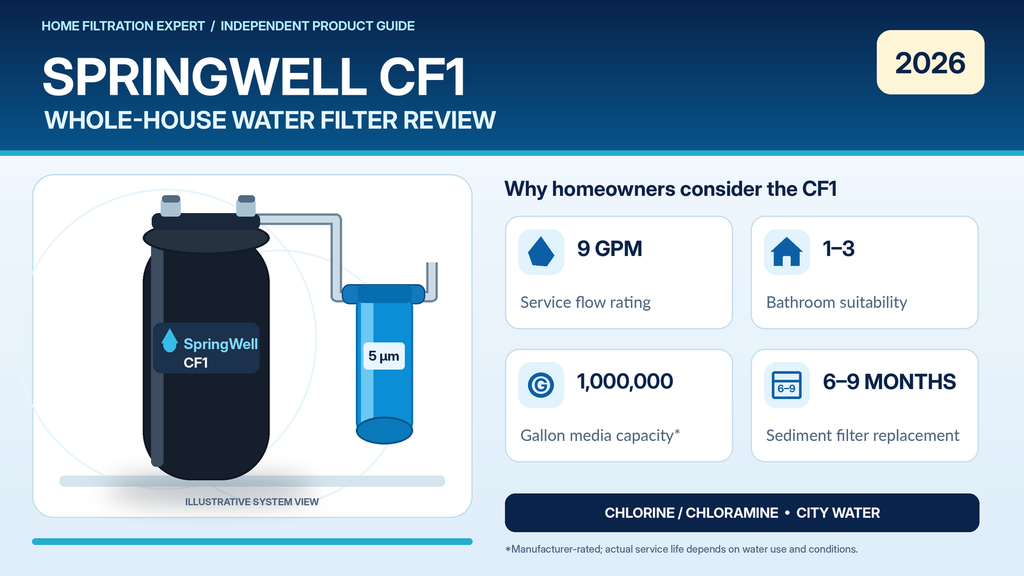
SpringWell CF1 review (2026) — quick verdict: The SpringWell CF1 is a serious whole-house city-water filter candidate for a home with one to three bathrooms, particularly where chlorine or chloramine taste and odor are the main complaints. Its 9 GPM published service flow, carbon/KDF media and relatively infrequent tank-media replacements are appealing. But for a household shopping specifically for PFAS or lead reduction, don’t treat SpringWell’s marketing claims as independent certification: we could not verify a finished-system model listing demonstrating those specific reductions in the sources reviewed.
Imagine finally dealing with that swimming-pool smell from the shower, the chlorine note in your kitchen water and the feeling that every faucet in the house needs its own little filter. It’s easy to see why a single filter fitted where the water enters the property sounds attractive.
That’s the promise of the SpringWell CF1: treat incoming municipal water before it reaches bathroom taps, sinks and showers. But when equipment costs significantly more than a filter pitcher, the right question isn’t simply ‘Does it filter water?’ It’s which water problem does it solve—and which ones does it not?
Editorial disclosure: This is a research-based review using published specifications, warranty terms and certification research. We have not purchased, installed or independently laboratory-tested the CF1. No affiliate links have been included.
The appeal is simple: Instead of fitting a small filter to one tap, a point-of-entry system treats the water before it travels around the home. If chlorine or chloramine taste and odor are what bother you in the kitchen and shower, the CF1 may be the kind of whole-house convenience you’re looking for. That makes the larger investment worth investigating—provided the system matches your water test, plumbing and household flow needs.
Table of Contents
Tired of treating every faucet separately?
Explore the CF1 whole-house setup, published 9 GPM rating and current packages on SpringWell’s official site.
Official manufacturer website. Check current specifications, pricing and availability before ordering.
SpringWell CF1 Review: Is This Whole-House Filter Worth Buying?
In this SpringWell CF1 review, we see the system as a potential fit for municipal-water households primarily targeting chlorine/chloramine taste and odor and seeking whole-home coverage. The combination of a high-flow media tank and a sediment stage is more convenient for household-wide treatment than continually filling a drinking-water pitcher.
The manufacturer describes long media life, a lifetime defect warranty and a 9 GPM service rating for the CF1. Those are attractive specifications if your plumbing and household demand suit the system.
But a buyer should know three important limitations. First, a whole-house carbon/KDF system is not the same as a dedicated iron-removal filter, water softener or UV disinfection system. Second, certification for materials or filter components does not automatically verify contaminant reduction by the assembled CF1. Third, the six-month return marketing badge has conditions: installed products generally cannot be returned simply because you’ve changed your mind.
Our conclusion is deliberately conditional: promising format for city-water aesthetic improvement; insufficient independently verified evidence in the sources reviewed to recommend the CF1 specifically for PFAS or lead mitigation.
SpringWell CF1 Specifications at a Glance
| Model | SpringWell CF1 (Core whole-house city-water filter) |
|---|---|
| Intended home size | One to three bathrooms |
| Rated service flow | 9 gallons per minute (GPM) |
| Connection size | 1 inch |
| Filter tank | 9 inches wide; 48 inches high (approximately 52 inches with head) |
| Operating pressure | 25–80 psi |
| Operating temperature | 36–120°F |
| Advertised media capacity | 1,000,000 gallons |
| Media replacement | Product page: up to 10 years or 1,000,000 gallons; check differing warranty performance period |
| Sediment cartridge | Replace approximately every 6–9 months |
| Primary media | KDF and catalytic carbon, plus sediment stage |
| Best starting use | Municipal water with chlorine/chloramine taste or odor issues |
| Well-water compatibility | Not a dedicated untreated-well, iron, manganese or sulfur treatment system |
The manufacturer sells other size configurations, including the CF4 for larger homes. Don’t assume the CF1 is enough simply because it is the cheapest option. The number of showers, fixture flow rates and simultaneous uses matter more than the bathroom count alone.
How Does the SpringWell CF1 Work?
Whole-house filtration begins at the water entry point
Unlike a kitchen-only filter, a point-of-entry system treats incoming water before it is distributed around the home. That can be useful if chlorine odor bothers you in both the shower and the kitchen.
The CF1’s media tank is designed for household flows rather than a single drinking-water faucet. SpringWell describes a staged treatment path that incorporates a KDF copper/zinc alloy bed, catalytic carbon and a 5-micron sediment filter.
KDF and catalytic carbon
KDF media is used in some water-treatment designs as part of a broader contaminant-reduction approach. Catalytic carbon is commonly selected for its interaction with certain disinfectants and organic compounds. However, media types alone don’t prove a specific reduction percentage for a finished system.
Contact time is important. As multiple showers and taps run, the system must still deliver water at a suitable rate while allowing enough contact with the media. The 9 GPM service rating helps buyers judge suitability; it is not a promise that every home will experience zero pressure loss.
Sediment filtration
The replaceable sediment stage is intended to capture certain suspended particles such as sand, silt and debris. It won’t correct an ongoing upstream contamination event or remove every dissolved chemical.
If your water has suddenly turned brown, start with our guide to brown or orange tap water before buying. A filter can’t repair corroded pipes or a deteriorating water heater.
What Does the CF1 Actually Remove?
Chlorine and chloramine
SpringWell explicitly markets the CF1 for chlorine and chloramine reduction and publishes a performance guarantee for its carbon media. If your drinking water has a chlorine taste or your shower water has a pronounced disinfectant odor, this is the most natural reason to evaluate this system.
The published warranty says SpringWell guarantees performance for chlorine/chloramine over six years or one million gallons. That’s worth comparing carefully with the current product page’s description of up to ten years of media life. They are not worded identically, so seek written clarification if the difference affects your purchase.
For a more complete diagnosis, see how to remove chlorine taste and smell from tap water.
PFAS, PFOA and PFOS: the certification issue
One important finding in our SpringWell CF1 review: SpringWell’s product page also advertises reduction of PFAS, including PFOA and PFOS. That is a manufacturer claim. Certification researchers checking finished-system listings in 2026 did not identify a public NSF, WQA or IAPMO model-specific finished-product listing demonstrating CF1 reduction of these compounds.
This distinction matters. A carbon medium may be able to reduce certain substances under specified conditions, but brand claims, laboratory test-method references and certified finished-system reduction claims are not interchangeable. For a household with confirmed PFAS, choose a system with a clearly identified, third-party-certified reduction claim for the substances in your water, or obtain verifiable independent evidence for the exact proposed installation.
Our PFAS water guide explains why the exact substance and filter certification matter.
What the CF1 is not intended to solve
- Hard water and limescale: A carbon-based CF1 is not a conventional water softener; removing chlorine does not mean removing hardness minerals.
- High iron or manganese: Specialized well-water treatment or pretreatment may be needed.
- Hydrogen sulfide or rotten-egg smell: A sulfur complaint may originate in a well or water heater and needs a targeted diagnosis.
- Microbiologically unsafe water: The manufacturer warns against using the system alone when the source is unsafe.
- Specific lead or PFAS hazards: Do not infer certified health-related reduction from the general filtration description.
For a puzzling sulfur odor, see why water smells like rotten eggs.
Sizing, Installation and Flow: What to Check Before Buying
Is 9 GPM enough?
The published CF1 service flow is 9 gallons per minute. That may suit many one-to-three-bathroom homes, but actual demand depends on the flow of individual showers, faucets, appliances and irrigation.
If two showers, a washing machine and other taps are operating simultaneously, total demand can become significant. Ask a plumber to estimate peak fixture demand and verify that the chosen system, house pressure and plumbing diameter are compatible.
Installation considerations
A CF1 normally requires access to the main incoming water line and enough space for the tall media tank, sediment housing and associated fittings. Check the 1-inch connection requirement against your home plumbing, and allow clearance for service and cartridge changes.
An experienced homeowner may be able to install suitable whole-house equipment, but professional installation is worth considering for correct shutoff, pressure control, leak prevention, drain or bypass arrangement if applicable, and local code compliance.
The CF1 is not marketed as an electrically powered, regularly backwashing iron filter, so its arrangement is simpler than some well-water systems. Simple, though, doesn’t mean universally DIY or maintenance-free.
One main-line installation could simplify your routine.
Compare CF1 sizing, installation requirements and sediment-filter servicing before you choose.
Official manufacturer website. Check current specifications, pricing and availability before ordering.
Maintenance, Warranty and Return Policy
The small cartridge still needs regular attention
SpringWell states that the sediment cartridge should be replaced approximately every six to nine months. This is a recurring cost that should be included even if the media tank lasts for many years.
A clogged prefilter can restrict flow. If you have frequent sediment, find out where it comes from before assuming larger or more expensive cartridges will solve the root problem.
Media life: clarify the numbers
The CF1 product page states one million gallons or ten years for the main media, while the carbon performance warranty specifies six years or one million gallons for chlorine/chloramine reduction. That difference is not proof the product will fail at six years, but it is a reason to request the exact warranty and replacement terms in writing.
A ten-year ownership calculation should include the media, sediment replacements, installation, optional fittings, service calls and any future changes in water quality. The original purchase price is only the beginning.
What does the lifetime warranty mean?
SpringWell publishes a manufacturer lifetime warranty against defects for specified covered parts, subject to its exclusions. A defect warranty is not the same as unlimited free annual maintenance or guaranteed contaminant reduction for every substance.
The six-month guarantee has important conditions
SpringWell’s published return policy says its six-month general return window is for products that remain unused, uninstalled and in undamaged packaging, with the buyer typically paying return shipping and a 10% restocking fee for approved non-defective returns.
Its separate performance promise involves troubleshooting and remedies; installed systems are generally not eligible for return unless SpringWell determines them defective. Read the full policy rather than assuming ‘six-month money-back guarantee’ means you can trial the installed system for six months and then send it back.
SpringWell CF1 Pros, Cons and Alternatives
What stands out
- Whole-house format instead of a kitchen-only drinking-water cartridge.
- 9 GPM published service-flow rating for the CF1.
- Targeted positioning for municipal-water chlorine and chloramine complaints.
- Long advertised media capacity with relatively infrequent main-media replacement.
- Published dimensions and operating limits make it easier to assess the fit.
What gives us pause
- A substantial purchase and installation commitment.
- No model-specific third-party certified CF1 PFAS or lead reduction established by our reviewed sources.
- Different ten-year media-life and six-year chlorine-performance-warranty wording.
- Sediment cartridges still require periodic replacement.
- The six-month return badge can mislead buyers unless the uninstalled-product restrictions are read carefully.
- Not intended as a universal well-water, limescale, sulfur or microbial safety solution.
CF1 vs. under-sink reverse osmosis
An under-sink RO system focuses on drinking and cooking water at one faucet, usually with a dedicated membrane and wastewater line. The CF1 treats incoming water for the whole home and may make sense when your primary aim is chlorine odor from multiple fixtures. Neither technology should be selected without confirming the water problem and product-specific evidence.
CF1 vs. an iron-removal well-water filter
These are different purchases. If a well test shows elevated iron, manganese or hydrogen sulfide, start with a specialist well-water treatment design rather than assuming a city-water carbon system will handle it. The brand itself sells separate systems for well-water problems.
Who Should Buy the SpringWell CF1?
SpringWell CF1 review buying recommendation: I’d consider putting CF1 on your shortlist if: you use treated municipal water, have a suitable one-to-three-bathroom home and want a single main-line solution for annoying chlorine/chloramine taste or odor rather than juggling separate kitchen and shower filters. Verify the size and plumbing requirements, then compare SpringWell’s current package with the cost of treating several points around the house.
Look elsewhere or seek more evidence if: You have confirmed PFAS or lead contamination, an untreated private well, bacterial contamination, serious iron staining or a hardness problem. Select a treatment system with independently verified performance for the substance that actually needs reducing.
If you are unsure whether your whole-house problem needs a carbon filter, softener, iron-removal system or drinking-water treatment, a proper water test is a far better starting point than picking whichever advert promises the longest media life.
Take our 15 Warning Signs Water Safety Check and explore Find the Right Water Filter for Your Home. Both are educational tools to support, not replace, appropriate water testing.
See current manufacturer details: SpringWell whole-house filter (CF1) (non-affiliate reference; availability, prices and terms can change).
Frequently Asked Questions
Does SpringWell CF1 remove chlorine?
The manufacturer specifically markets it for chlorine and chloramine reduction and offers a corresponding carbon-performance guarantee. For measured reduction requirements, request model-specific independent test evidence and check whether it meets your needs.
Is the CF1 certified to remove PFAS?
We could not verify a finished-system third-party certification listing establishing PFAS reduction for the CF1 in the sources reviewed. The manufacturer’s promotional claim should not be presented as a certified claim.
Will the CF1 remove hardness or stop limescale?
It is not a traditional water softener. If high hardness causes scaling, choose a treatment specifically intended for hardness management.
Can I install the CF1 with a private well?
It is primarily marketed for city water. Untreated well water may need separate testing and pretreatment for iron, manganese, sulfur or other substances. Consult the manufacturer and an experienced local well contractor.
How often should the sediment filter be changed?
SpringWell specifies approximately every six to nine months, adjusted to actual water conditions.
Does the CF1 last ten years?
The product page currently advertises up to ten years or one million gallons of media life. The carbon performance warranty uses six years or one million gallons. Confirm which obligation applies to your planned use.
Can I return it after installing it?
Generally not under the ordinary six-month return policy simply because you changed your mind. SpringWell’s published terms restrict standard returns to unused, uninstalled products; remedies for defective installed systems are addressed separately.
If city-water chlorine odor is the problem, this deserves a closer look.
Check the current CF1 offer, included components and written warranty terms directly with SpringWell.
Official manufacturer website. Check current specifications, pricing and availability before ordering.
Sources and Editorial Research Method
This SpringWell CF1 review is a specification-based analysis, not a claim of having used the product. We compared SpringWell’s official product information, warranty and returns language with independent reporting on model-specific certification listings. We give greater weight to published certified contaminant claims than to unverified marketing language.
- SpringWell — CF1 product specifications and advertised contaminant claims
- SpringWell — written warranty and carbon performance guarantee
- SpringWell — shipping, returns, restocking fees and installed-system conditions
- TapWaterData — CF1 model-specific certification research
- NSF — understanding certified reduction claims
Safety note: Filtration equipment should never override a public-health notice. If harmful contamination is suspected, use a known-safe water source and seek laboratory testing or professional advice suited to your circumstances.